“I’ll take that.”
The Swedish engineers were taken aback. What did he mean? After all, it was a presentation by the Water Engineering Bureau, not a catalog of products that King Faisal bin Abdul Aziz was leafing through.
But how do you say no to an oil-rich Saudi ruler who is about to sign a lucrative contract for an extensive irrigation system? And who isn’t the least bit interested in the objection that the mushroom-shaped tower in the catalog has just become a nationally recognized symbol of a medium-sized city—completely unknown in Riyadh—somewhere in a country halfway to the North Pole?
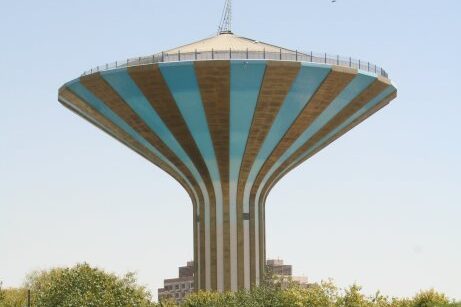
Of course, that wasn’t done. With worried expressions, the engineers returned to Sweden. What would the people of Örebro say? A formal presentation to the city’s urban planning office was arranged. It’s not hard to imagine the surprise of the delegation from Närke when the question was raised. The answer was positive. The construction of the replica was approved in order to, as it was put, “avoid any complications between Örebro and Saudi Arabia.”
33 percent and 13 years later
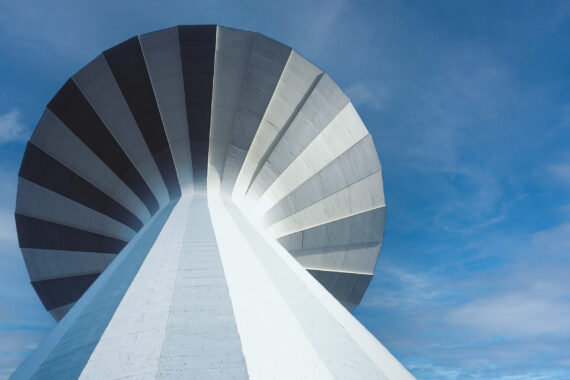
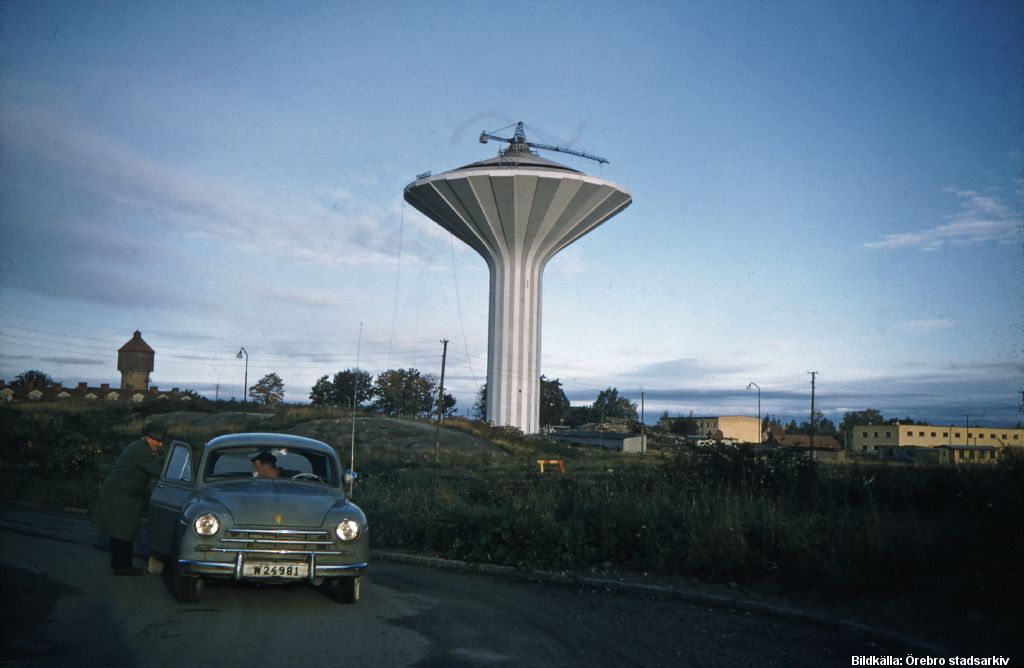
What the potential implications might be between a small Swedish town with just under 70,000 residents and the world’s most powerful oil nation, however, remained unclear. The “Mushroom’s” architect, Sune Lindström, was brought back on board, and soon the Saudi tower took shape. The design was identical to the original in Örebro, but the Swedish “mushroom” was considered too flimsy. Lindström therefore increased its size by 33 percent, and thirteen years after the original’s inauguration, Riyadh’s new pride and joy was completed.
The king’s interest in water towers was no coincidence. It is perhaps not so surprising that water supply is a matter of great concern in a country where one-third of the land is desert. But Feisal had decided to go down in history as the man who permanently resolved this issue—which, for the Saudis, had until then been both perennial and urgent. “I want to be known to the people as the King of Water,” he declared.
“I want the people to know me as the king of the waters,” he declared.
To the rest of the world, he became better known as the “oil king.” In the 1960s, he built up the country’s oil industry, only to completely cut off oil supplies to countries that supported Israel in 1973. The result was a major oil crisis that paralyzed the Western world for several years. The drama did not end there. Two years later, he was assassinated by his nephew at a family dinner.
9 million visitors
Back to the water tower. A key difference from the original design was the absence of a restaurant. “No one should be able to look down on the royal family,” was the reasoning. Since the city leaders in Örebro did not share this view, the Närke tower has, over the years, become one of Sweden’s most famous tourist destinations. Over nine million visitors have taken the elevators—originally operated by uniformed elevator boys—up to enjoy good food, drinks, and the view, which was breathtaking in its day.
Perhaps it is the lack of a restaurant that has prevented the Saudi mushroom from ever achieving the iconic status of the original. But in 2014, Örebro’s water authorities probably wished they had followed King Faisal’s lead. One of the restaurant’s toilets sprung a leak, and suddenly the entire city of Örebro was left without drinking water. The result is that in a few years, Svampen will transition entirely into a tourist attraction as it is replaced by a brand-new water tower, Lyra. Closed to the public and definitely without a toilet atop the water reservoir.
In Riyadh, too, the idea of a new water tower is being discussed. Nothing has been decided yet, but there are plans for a tower standing over 400 meters tall. Once again, the Saudis apparently want to outdo everyone else. Incidentally, in neighboring Kuwait, there’s a whole little forest of mushrooms inspired by Örebro. But that’s a whole other story.
More about Svampen